
.svg)

Day 1 – From Cagliari to Sant’Antioco
Independent arrival in Cagliari at approximately 12:30 p.m.
Transfer by public transport from Cagliari to Sant’Antioco (approximately 2 hours 30 minutes).
Day 2 – From Maladroxia to Grutti ‘e Acqua
Hike from Maladroxia to the Nuragic site of Grutti ‘e Acqua (16.5 km, 5 hrs 30 min, +460 m ascent, -420 m descent).
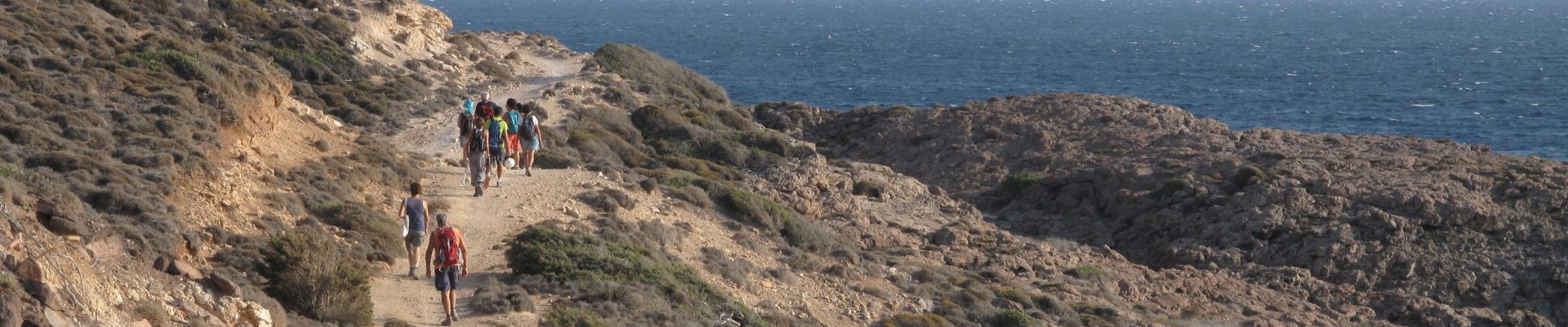
We walk along the southern part of the island with continuous sea views, passing beyond Capo Sperone and overlooking the wild southern coastline. A trail through Mediterranean scrub leads us to the inlet of Porto Sciusciau and then to the small lake around which the ancient Nuragic settlement once stood.
Day 3 – Excursion to Cala Lunga
Hike to Cala Lunga (15 km, 5 hrs, +330 m ascent and descent). We cross the entire island through rural and pastoral landscapes before descending to the western coast and the spectacular Cala Lunga, a deep inlet with a beautiful sheltered beach.
 AIGAE Certified Hiking Guide for the Piedmont Region – Roberta FerrarisAccommodation with breakfast includedDinners as specified in the itineraryEntrance fees and guided visits included in the programBus and train transfers during the tripTravel insurancePre-departure video call to present the tourA special welcome gift
 Travel to and from CagliariAnything not specifically listed under “What's Included”
We are in south-western Sardinia, where the Mediterranean crashes with ocean-like waves against the dramatic trachyte cliffs of the islands of Sant’Antioco and San Pietro. Spectacular landscapes await us as we walk across the entire island of Sant’Antioco, following a trail dedicated to Saint Antioco, who lived during the 2nd century AD. The vibrant heart of the town will be our base for discovering one of the oldest settlements in Sardinia and the Mediterranean. Beneath the modern town lies the ancient Punic city of Sulky, a remarkable historical treasure that we will explore through visits to the Archaeological Museum and the Sea Museum, immersing ourselves in the timeless atmosphere of this unique place.
From Sant’Antioco, we head to Carloforte, a charming fishing village where the Genoese language is still spoken today by the Tabarchino community. Originally from Genoa, this community settled in Tunisia during the 16th century before being welcomed to Sardinia in the 18th century.
Finally, we venture inland to discover the abandoned village of Tratalias and its magnificent Romanesque cathedral. From there, it is only a short distance to the salt pans, where a nature walk introduces us to the lagoon environment, a true paradise for flamingos.
Region, Society & Environment: The Sulcis region has moved beyond its mining past, although traces of this history can still be seen throughout the landscape. The era of large-scale tuna fishing, once a major activity along Sardinia's western coast, has also largely come to an end. However, Carloforte is still home to an active traditional tuna fishery and a processing facility for prized bluefin tuna. Western Sardinia has never attracted mass tourism, largely due to the strong mistral winds and often rough sea conditions. In recent years, several marked walking routes have been created and promoted, including the Santa Barbara Mining Trail and the newer Way of Saint Antioco, attracting travelers who value nature, landscapes, and responsible tourism.
Itinerary: Center-based holiday. Most walks take place on trails and rural tracks, with a few sections along quiet paved roads.
Difficulty Level: Easy.
Guide: Roberta Ferraris, certified environmental hiking guide for the Piedmont Region and licensed tour leader. She is the author of Sardinia on Foot: 11 Spectacular Coastal Itineraries, published by Terre di Mezzo Editore.
Highlights:
The wild western coastline of Sant’Antioco
The charming fishing village of Carloforte
Flamingos soaring above the salt pans
Food & Local Specialties: Fresh fish and seafood, including Carloforte’s renowned tuna and bottarga, the excellent local